3
0
1
Gantry Crane
1
1
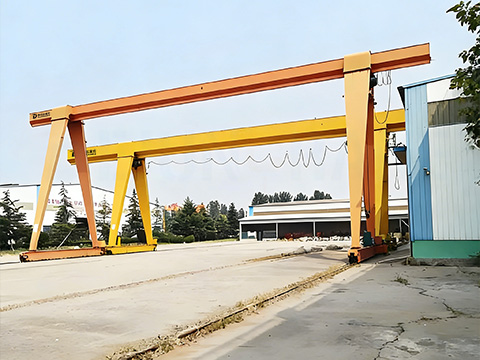
The greatest advantages of gantry cranes are their high space utilization, wide operating range, broad adaptability, and versatility, making them particularly suitable for heavy-duty lifting and loading/unloading operations in outdoor open-air settings.
🏗️ Key Advantages
- Simple structure, low failure rate: The hoisting structure runs on ground-level tracks, eliminating potential sources of failure associated with tire-mounted trolleys or diesel generator sets, resulting in more reliable operation.
- Controllable operating costs: Powered by electricity, it requires no oil changes, uses minimal maintenance supplies, and incurs low repair costs, offering significant economic benefits.
- High level of automation: With fixed tracks and a trolley positioning device, the crane is less prone to drifting when handling heavy loads, facilitating precise control and automated operations.
- Environmentally Friendly and Energy-Efficient: Powered by an external power source, it produces virtually no noise or air pollution and can recover electrical energy during descent via an energy recovery system.
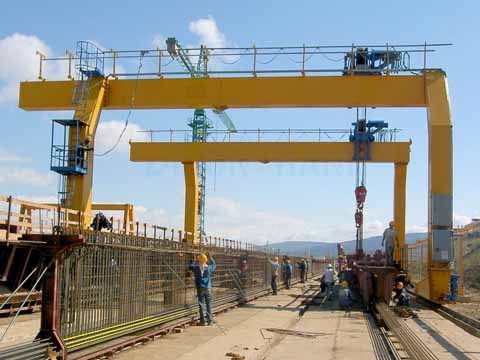
- High Load-Carrying Capacity: The double-girder structure allows for extremely high lifting capacities; for example, the world’s largest gantry crane with a lifting capacity of 3,800 metric tons is already in operation.
🚢 Main Applications
- Ports and Terminals: Container loading, unloading, transshipment, and stacking; these cranes serve as core equipment for automated operations in smart ports.
- Shipbuilding Industry: Assembly, turning, and lifting of ship sections; large shipyards are typically equipped with gantry cranes ranging from 100 to 1,000 metric tons.
- Hydroelectric Power Plants: Opening and closing of gates, installation of electromechanical equipment, with lifting capacities ranging from 80 to 500 metric tons.
- Open-air cargo yards/material yards: Loading and unloading of bulk materials such as coal, ore, and sand and gravel, using grab buckets or electromagnetic lifting magnets.
- Wind power equipment manufacturing: Final assembly, transport, and integrated construction of heavy steel structural components such as deep-sea wind turbine towers and jacket structures.
- Bridge engineering: Lifting of large-span, high-precision steel structures, such as in the construction of river-spanning bridges.
⚠️ Selection Tips For Gantry Crane
- For lifting capacities under 50 metric tons and spans within 35 meters, a single-girder crane is more economical; for applications requiring wider gantry legs, higher speeds, or frequent handling of heavy loads, a double-girder crane is more suitable.
- For outdoor operations, pay attention to wind resistance and anti-slip measures; operations should be suspended and the crane anchored when wind speeds exceed Force 6.
🏗️ Key Advantages
- Simple structure, low failure rate: The hoisting structure runs on ground-level tracks, eliminating potential sources of failure associated with tire-mounted trolleys or diesel generator sets, resulting in more reliable operation.
- Controllable operating costs: Powered by electricity, it requires no oil changes, uses minimal maintenance supplies, and incurs low repair costs, offering significant economic benefits.
- High level of automation: With fixed tracks and a trolley positioning device, the crane is less prone to drifting when handling heavy loads, facilitating precise control and automated operations.
- Environmentally Friendly and Energy-Efficient: Powered by an external power source, it produces virtually no noise or air pollution and can recover electrical energy during descent via an energy recovery system.
- High Load-Carrying Capacity: The double-girder structure allows for extremely high lifting capacities; for example, the world’s largest gantry crane with a lifting capacity of 3,800 metric tons is already in operation.
🚢 Main Applications
- Ports and Terminals: Container loading, unloading, transshipment, and stacking; these cranes serve as core equipment for automated operations in smart ports.
- Shipbuilding Industry: Assembly, turning, and lifting of ship sections; large shipyards are typically equipped with gantry cranes ranging from 100 to 1,000 metric tons.
- Hydroelectric Power Plants: Opening and closing of gates, installation of electromechanical equipment, with lifting capacities ranging from 80 to 500 metric tons.
- Open-air cargo yards/material yards: Loading and unloading of bulk materials such as coal, ore, and sand and gravel, using grab buckets or electromagnetic lifting magnets.
- Wind power equipment manufacturing: Final assembly, transport, and integrated construction of heavy steel structural components such as deep-sea wind turbine towers and jacket structures.
- Bridge engineering: Lifting of large-span, high-precision steel structures, such as in the construction of river-spanning bridges.
⚠️ Selection Tips For Gantry Crane
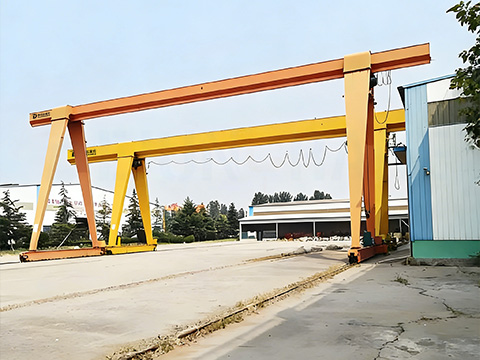
- For lifting capacities under 50 metric tons and spans within 35 meters, a single-girder crane is more economical; for applications requiring wider gantry legs, higher speeds, or frequent handling of heavy loads, a double-girder crane is more suitable.
- For outdoor operations, pay attention to wind resistance and anti-slip measures; operations should be suspended and the crane anchored when wind speeds exceed Force 6.